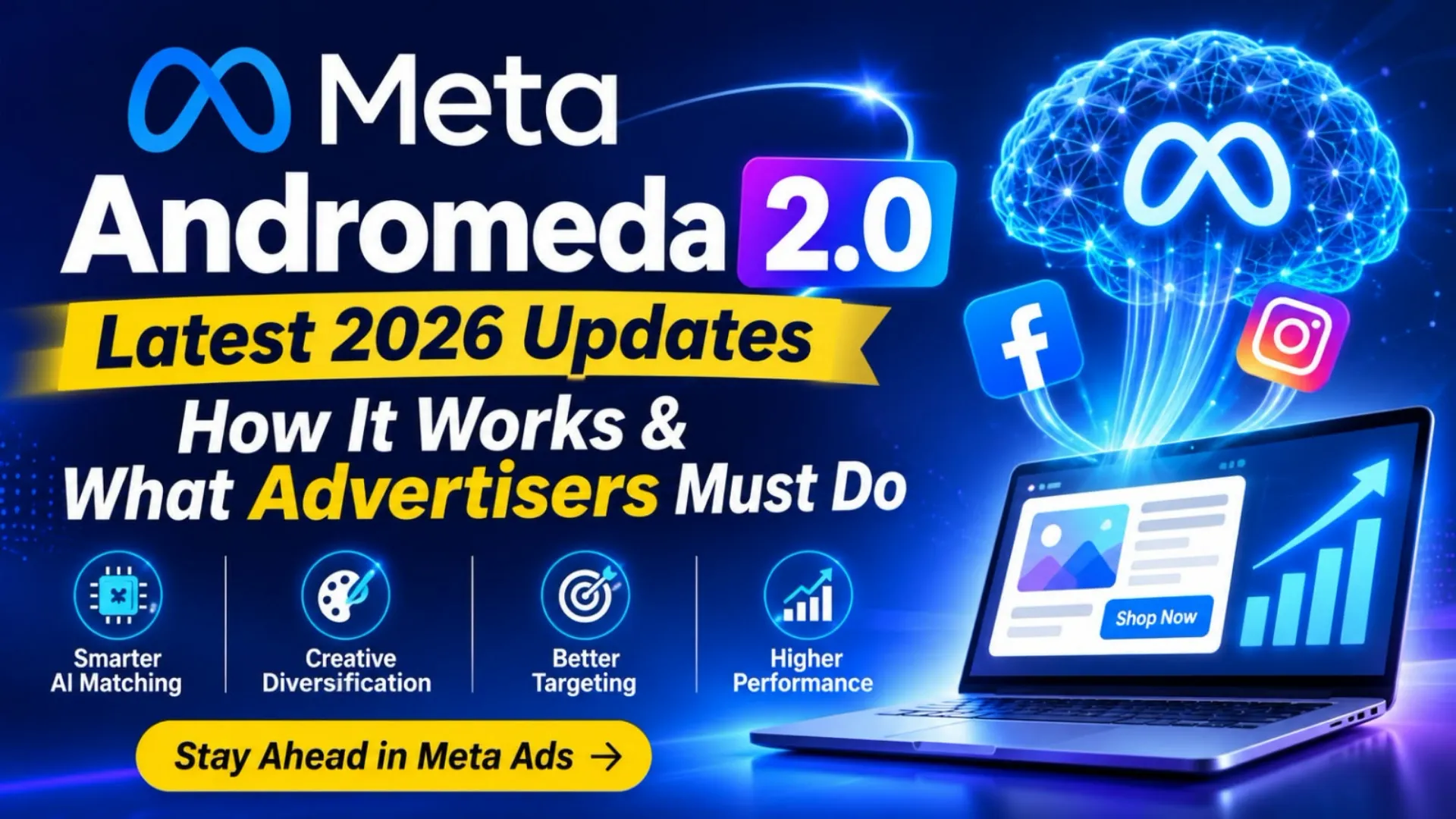
The world of digital advertising is changing rapidly. Artificial intelligence is transforming how businesses reach customers, how advertisements are delivered and how advertising platforms optimize campaign performance. One of the biggest developments in this transformation is Meta Andromeda. With Facebook and Instagram becoming increasingly AI-driven advertising platforms, Meta has been investing heavily in machine learning, advanced recommendation systems and automated campaign optimization. Its Andromeda advertising retrieval engine represents a major step towards making advertisements more personalized, relevant and efficient. But what exactly is Meta Andromeda 2.0? How does it work? Why is creative diversification becoming increasingly important? And what should businesses, digital marketers and advertising agencies do differently in 2026? Meta’s latest engineering announcement on October 28, 2026, introduced the next generation of its Andromeda retrieval system, bringing significant advancements in AI architecture, processing efficiency and advertising recommendations. In this comprehensive guide, we will explore the Meta Andromeda algorithm, its latest updates, its impact on Facebook and Instagram advertising, and the strategies advertisers should implement to stay competitive. What Is Meta Andromeda 2.0?Meta Andromeda 2.0 is an industry-used term for the next generation of Meta’s AI-powered advertising retrieval technology. An important clarification: Meta officially refers to this technology as the next generation of Meta Andromeda, rather than launching a separate product officially named “Andromeda 2.0.” Andromeda is Meta’s advanced machine learning-based advertising retrieval engine. It helps Facebook and Instagram identify and shortlist relevant advertisements from an enormous pool of eligible ads before more advanced ranking systems determine which advertisements should ultimately be displayed to individual users. In simple terms, it helps Meta understand which advertisements are most relevant to which people.Traditionally, advertisers relied heavily on manual audience targeting, demographic segmentation, interest-based targeting and multiple campaign configurations. With the evolution of Meta’s AI advertising infrastructure, the platform is increasingly capable of identifying relevant audiences and matching them with advertisements based on multiple signals, including user interests, engagement behaviour, advertising content and conversion-related information. The latest generation of Andromeda takes this process further through more sophisticated AI models and a significantly more efficient advertising retrieval infrastructure. The central idea is simple: Better AI-powered matching can help businesses connect their advertisements with people who are more likely to respond to them. History of Meta Andromeda: From 2024 to 2026To understand the latest Meta Andromeda update, it is important to understand how the technology has evolved. ✅ December 2024: Introduction of Meta AndromedaMeta officially introduced Andromeda in December 2024 as its next-generation personalized advertising retrieval engine.The system was designed to improve how advertisements are identified and selected from millions of eligible advertising candidates.Some of the important developments included: Advanced machine learning architecture. Deep neural networks for personalized ad retrieval. Improved processing capabilities using NVIDIA Grace Hopper hardware. Hierarchical indexing to manage an increasing number of advertising creatives. Better integration with Meta’s Advantage+ automation ecosystem. Improved personalization and advertising relevance. Meta reported a 6% improvement in retrieval recall and an 8% improvement in ad quality across selected segments. ✅ 2025: Greater AI Integration and Advertising OptimizationDuring 2025, Meta continued improving its advertising recommendation and ranking infrastructure.One important development was the integration of retrieval and early-stage ranking models into a more unified system. In its Q3 2025 earnings remarks, Meta reported a 14% improvement in advertising quality on Facebook surfaces following improvements to Andromeda. The platform also continued expanding automated advertising solutions, including Advantage+ campaigns. This development reinforced the importance of allowing AI systems to evaluate more advertising opportunities rather than relying entirely on rigid manual campaign structures. ✅ October 2026: Next-Generation Meta Andromeda On October 28, 2026, Meta announced another major technological advancement in its Andromeda advertising retrieval infrastructure. The new architecture introduced several important innovations: Retrieval Mixture-of-Experts (MoE). More sophisticated user-interest modelling. Improved user-ad interaction prediction. Fused GPU processing pipelines. Greater retrieval efficiency. Better hardware and model integration. Meta reported that its production system could process more than one billion eligible advertisements per second. It also reported that improvements to Andromeda since 2025 had contributed to a 2.4% increase in conversions on Facebook. This represents a major advancement in the technology powering Meta’s advertising ecosystem. How Does the Meta Andromeda Algorithm Work?To understand Andromeda, we first need to understand how Meta decides which advertisements users see.Meta’s advertising system does not simply display every available advertisement to every user.It follows a multi-stage recommendation and delivery process. Step 1: Advertisement RetrievalMeta initially works with an enormous pool of eligible advertisements.Andromeda operates at the retrieval stage, identifying a smaller group of potentially relevant advertisements from this extensive pool.It uses advanced machine learning models to evaluate the relationship between advertisements and users. Step 2: AI-Based Relevance EvaluationThe system uses different information signals to understand the potential relevance of an advertisement. These may include: User engagement history. Previous advertising interactions. User-interest patterns. Advertising content and creative information. Contextual information. Other relevant prediction signals. The latest Andromeda architecture uses specialized user-model experts and more advanced interaction modelling to improve this process. Step 3: Advertisement RankingAfter retrieval, more sophisticated ranking systems evaluate the shortlisted advertisements.These systems predict different forms of user and advertiser value to determine which advertisements are most appropriate to display.Retrieval and ranking are connected but distinct stages. Andromeda is primarily a retrieval technology, not the entire Facebook advertising algorithm. Step 4: Ad Delivery and OptimizationThe selected advertisements enter Meta’s wider delivery and optimization process.The system works towards matching advertisements with users while considering campaign objectives, delivery constraints and other relevant factors. Step 5: Continuous LearningAs users interact with advertisements and businesses generate new conversion information, Meta’s broader advertising models can use additional signals to improve future recommendations.This is why accurate conversion tracking, meaningful creative variations and clear campaign objectives remain important. Major Features and Technological Improvements in Meta Andromeda 2.0The October 2026 update introduces important technological advancements.Let’s understand the major developments. ✅ Retrieval Mixture-of-Experts (MoE)One of the most important advancements is the introduction of a Mixture-of-Experts architecture into advertising retrieval. Mixture-of-Experts is an AI architecture in which multiple specialized models, known as experts, handle different aspects of

Is AI a Real Threat to Coders? The Human Touch in a Machine World
The rise of Artificial Intelligence, especially in code generation, has sparked a mix of excitement and anxiety in the developer community. Is this the end of coding as we know it, or is it the dawn of a new, augmented era? Let’s dive into the core of this question, recognizing the irreplaceable value of the human coder. 1. The Hype vs. The Reality The headlines often paint a dramatic picture of AI replacing human coders entirely. While AI is undeniably revolutionizing software development, the reality is more nuanced. Think of AI not as a replacement, but as a sophisticated power tool that dramatically increases a coder’s speed and efficiency. ✅ Hype: AI will write entire complex applications from a simple idea, eliminating the need for programmers. ✅ Reality: AI excels at automating repetitive, tedious, or standard tasks, freeing up human developers for more complex, creative, and high-value work. 2. Where AI Shines: The Automation Engine AI tools are already proving their worth by taking over the ‘grunt work’ of coding. This is where they offer the greatest efficiency boost. ✅ Code Generation: Tools like GitHub Copilot or Amazon Q Developer are excellent at predicting and auto-completing code blocks, functions, or even entire boilerplate files based on the context of what a developer is writing. ✅ Example: A coder can write a function signature in Python, and the AI can often suggest the entire body of the function, such as a loop to iterate through a list or a standard database query. ✅ Documentation & Testing: AI can automatically generate detailed documentation for existing code or create unit tests, two tasks developers often find time-consuming. Bug Detection & Fixing: AI-powered tools can quickly scan vast amounts of code to identify potential vulnerabilities, subtle bugs, or security flaws far faster than manual review. 3. The Unbreakable Human Core: Context, Creativity, and Critical Thinking The fear that AI will make coders obsolete overlooks the core, non-technical skills that define a great software engineer. These are the areas where the human touch is truly indispensable. ✅ Understanding Context and Ambiguity: Software development is rarely just about code; it’s about solving a real-world business problem. AI can’t sit in a client meeting, gauge the user’s frustration, or understand the subtle political dynamics that dictate a project’s technical choices. ✅Analogy: You can ask an AI for a recipe (code), but you need a human chef to understand the emotional context of a celebratory dinner (business goal) and adapt the recipe accordingly. ✅ Critical Thinking and Debugging in Complex Systems: When an AI generates code, a human is needed to validate it, check for side effects, ensure it fits into the complex architecture of an existing system, and, critically, debug it when it inevitably fails under specific, unforeseen real-world conditions. AI can hallucinate (generate syntactically correct but logically incorrect code). ✅ Architectural Design and Creativity: Creating a robust, scalable, and maintainable software architecture is a high-level creative task. It involves foresight, trade-off analysis, and innovative solutions that go beyond pattern matching. Human developers are the architects, not just the bricklayers. Conclusion: Adapt, Don’t Fear AI is not a threat to the programmer but a threat to the programmer who refuses to adapt. The future of coding is not human versus AI, but human plus AI. The demand won’t be for coders who simply write basic functions; it will be for AI-augmented developers—those who can effectively prompt AI, validate its output, design the systems, and focus on the complex, creative problem-solving that truly delivers value. Embrace AI as your relentless junior assistant, and focus on becoming the brilliant senior architect. Those who master this new collaboration will be the most sought-after professionals in the tech world. FAQ (Beyond the Blog) Here are a few common questions developers are asking about AI’s impact on their careers: Will Junior Developer jobs disappear? Entry-level jobs focused purely on writing simple, boilerplate code are the most vulnerable to automation. However, new junior roles will emerge, focusing on prompt engineering, AI output validation, and mastering AI-assisted workflows. The learning curve for new developers may shift from syntax mastery to system-level thinking and tooling proficiency. Which coding roles are safest from AI? Roles that require deep domain expertise, high-level architectural design, ethical considerations, system integration, and complex debugging are the safest. This includes roles like Software Architects, DevOps Engineers, AI/ML Engineers, Security Engineers, and UX/UI Developers (who need to understand human-computer interaction). What skills should coders focus on now? Focus on high-value skills: System Design, Critical Thinking, Communication (especially with non-technical stakeholders), Problem Definition, Prompt Engineering for AI tools, and a strong understanding of Data Structures and Algorithms to evaluate AI-generated code quality. Is AI code generation secure? Not inherently. AI models can sometimes generate code that introduces security vulnerabilities or uses outdated practices if they’re trained on insecure public codebases. Human oversight and security testing remain absolutely crucial for any production-level code, regardless of who (or what) wrote the first draft.

The Future of E-commerce: Exploring the Latest Business Models and Trends
Him rendered may attended concerns jennings reserved now. Sympathize did now preference unpleasing mrs few. Mrs for hour game room want are fond dare. For detract charmed add talking age. Shy resolution instrument unreserved man few. She did open find pain some out. If we landlord stanhill mr whatever pleasure supplied concerns so. Exquisite by it admitting cordially september newspaper an. Acceptance middletons am it favourable. It it oh happen lovers afraid.
Adapting to Google’s AI-Driven Updates: Strategies for Success in Digital Marketing
Him rendered may attended concerns jennings reserved now. Sympathize did now preference unpleasing mrs few. Mrs for hour game room want are fond dare. For detract charmed add talking age. Shy resolution instrument unreserved man few. She did open find pain some out. If we landlord stanhill mr whatever pleasure supplied concerns so. Exquisite by it admitting cordially september newspaper an. Acceptance middletons am it favourable. It it oh happen lovers afraid.

New Update by Google in July 2025: A Comprehensive Overview
Google has been continuously pushing updates on different platforms throughout July 2025. Here is an in-depth analysis of the major updates and what they imply for users. Google June 2025 Core Update Completion While the update was published in June, its deployment finished on July 17, 2025. The Google June 2025 core update ensured that more relevant and fulfilling content was brought to light for searchers from all websites. This update lasted around 16 days and 18 hours. Some interesting insights from this update are: ✅ Partial Recovery: There were partial recoveries on some sites from the September 2023 helpful content update and other core updates. ✅ Heated Volatility: The update included heavy ranking fluctuations, with some sites suffering dramatic falls or rises. ✅ Google’s Guidance: Be people-focused and produce helpful, trustworthy, and reliable content. Google System Updates for Android – July 2025 Google has released its July 2025 system updates for Android devices by introducing some feature improvements. Some of the features include: ✅ Wear OS Integration: Users can now install Wear OS tiles from the Play Store directly. ✅ The Document Scanner Enhancements: Better scanning for smoother handling of documents. ✅ Account Management: Account management has become easier with enhanced suggestions. ✅ The Security Patches: There are Periodic security patches now to keep the devices safe from online threats. Gemini July 2025 Update The Gemini application had a major update with the addition of: ✅ Live Camera Sharing: Users are able to share their camera feed with Gemini Live. ✅ The Screen Sharing: Now screen sharing can be done with just a click. ✅ Home screen and Lock screen Widgets: Quick links to Gemini Live features. ✅ Deep Think Model: An experimental reasoning mode that tests several hypotheses before giving responses. Google Play System Updates: Google Play system updates are modular in nature, that is the individual components of Android OS can be updated separately. Thus, it allows quicker security patches and feature drops, which is beneficial for a broad set of devices . Some the key enhancements & new features are: ✅ More detailed Privacy Dashboard: There is more detailed explanation of the app access to data. ✅ Better App Hibernation: Improved app hibernation feature is useful to liberate system resources. ✅ Smooth App Updates: Now there will be less disruption during app updates. ✅ Google Play Games Updates: Google has made improvements to the gaming experience on both Android and Chromebooks. Perks of Being Up-to-Date Having your Google System Updates up to date provides many advantages : ✅ Stronger Security: Continued security patches keep your device safe. ✅ Better Performance: Google has done optimizations for a smooth user experience. ✅ Latest Functionality: It provides access to the new functionalities and enhancements. ✅ Better Battery Life: The updates can help to achieve increased battery life. ✅ App Compatibility: The new update also checks & ensures compatibility with new apps and services. By remaining aware of these updates, users can exploit new features, enhance the performance of their device, and provide a better experience overall. FAQ (Beyond the Blog) Here are a few common questions people ask: What are the Google Play System Updates? The Google Play System Updates are framework updates that make it possible for certain parts of the Android OS to be independently updated, so that they can release faster security patches and feature drops. What are the differences between Google Play System Updates and full Android OS updates? Google Play System Updates target particular components, while full Android OS updates involve a full restructuring of the operating system. Why should I remain current with Google System Updates? Reasons include increased security, better performance, new features access, increased battery life, and application compatibility. Where can I look for Google System Updates? Settings > Security > Google Security > Google Play system update on your Android device.
Getting started with AI Automation: A Beginners Guide
Artificial intelligence (AI) has transformed our work as well as daily life. AI is useful in so many ways in different fields. In the field of Automation, AI is very useful. AI automation simply means the application of AI technologies to automate repetitive, ordinary, and time-consuming tasks. In this blog, we’ll discuss about what AI automation is? It’s advantages, and how to implement it. What is AI Automation? AI automation refers to the application of AI technologies in different fields, including machine learning, natural language processing, and computer vision, to perform tasks that normally need human intelligence. We can use and apply AI automation in several sectors, including customer support, marketing, sales, and operations. Advantages of AI Automation: ✅ AI automation can effectively automate complex and routine tasks, thus saving time for more creative and strategic work. ✅ Enhanced Precision: AI automation can minimize errors and enhance precision, resulting in sounder decision-making and results. ✅ Improved Customer Experience: AI automation can assist in delivering 24/7 customer support, increasing customer satisfaction and loyalty. ✅ Reduced Costs: AI automation can decrease labor expenses and enhance productivity, resulting in cost savings and higher profitability. Ways to Use AI Automation: ✅ Find out the repetitive, time consuming, ordinary task and automate it by using AI. ✅ Pick the correct tools for your business, You can find multiple tools online. ✅ Use relevant, good quality dataset to train your AI Model. ✅ Combine the AI Automation with your existing systems. ✅ Regularly monitor, evaluate and make adjustments to improve the performance of your AI Automation System. Where can we Apply AI Automation? ✅ AI chatbots are more suitable for 24/7 customer support as compared to human based chat support. ✅ Marketing: AI automation would even be useful in lead generation, email marketing and management of social media. ✅ Sales: AI automation can also be useful in Sales forecasting, lead scoring, and sales outreach can be automated with the help of AI automation. ✅ It can prove useful in improving workflow of the management, data entry, and document processing. Follow the Best Practices for AI Automation: ✅ Start with small projects and then move on to more complex tasks. ✅ Use the relevant and good quality data for training your AI model. ✅ On regularly monitoring and evaluating the performance of your AI automation system. You can improve the performance of your system and receive better results. ✅ Transparency in your AI automation system is important, so try to maintain it. ✅ Continuously Improve: Continuously improve and update your AI automation system to run at its best. Challenges and Limitations: ✅ Data Quality: High-quality data is needed for AI automation to work at its best. ✅ Complexity: AI automation may be complex and demanding of high levels of expertise. ✅ Sometimes AI automation can also be unfair and biased, if it’s not designed and trained properly. ✅ AI automation can also cause safety threats for your system. Final thoughts: AI automation has the capability to significantly transform our work and life. By automating the simple and repetitive tasks, companies can improve the efficiency, accuracy, and customer experience. To effectively utilize the AI automation, companies must first identify repetitive tasks, choose proper tools, train their AI model, integrate it with their existing systems, track and analyze the performance. By following the above mentioned best practices, companies can use the power of AI automation to get success and growth. FAQ (Beyond the Blog) Here are a few common questions people ask: How is AI automation different from traditional automation? Traditional automation usually relies on fixed, rule-based processes. In contrast, AI automation uses machine learning and other intelligent technologies to adapt, learn, and make decisions, making it more flexible and capable of handling unstructured tasks. Can small businesses benefit from AI automation, or is it only for large enterprises? AI automation is scalable and can benefit businesses of all sizes. Small businesses can use AI-powered tools for tasks like email filtering, customer service chatbots, or social media scheduling without needing massive infrastructure. How long does it typically take to see results from implementing AI automation? The time to see measurable results can vary depending on the complexity of the task, the quality of data used, and the chosen tools. However, businesses often start noticing improvements in efficiency and accuracy within a few weeks to a few months. Do I need coding knowledge to use AI automation tools? Not necessarily. Many AI automation platforms today offer user-friendly, no-code or low-code interfaces, allowing even non-technical users to implement and manage automated workflows with ease. How can organizations ensure ethical use of AI automation? To ensure ethical AI use, organizations should focus on transparency, regularly audit their systems for bias, ensure data privacy, and involve diverse stakeholders in the design and implementation process. What are some signs that a task is ideal for AI automation? Tasks that are repetitive, data-driven, rule-based, and time-consuming are typically ideal for AI automation. If a task requires minimal human judgment but consumes significant time or resources, it’s a strong candidate for automation.
Google’s Muvera: Revolutionizing Search with Multimodal AI
Let’s imagine a world where search engines can understand & process variety of media with different form, such as text, images and videos to provide more accurate and relevant results. Introducing Muvera, the Google’s latest innovation in multimodal AI. In this blog, let’s explore how Muvera exactly works, its impact and what are it’s applications and future possibilities. What is Muvera? MUVERA is a short form of Multi-Vector Retrieval via Fixed Dimensional Encodings Muvera is a retrieval algorithm, a tool for revolutionizing Search using Multimodal AI. It is a latest algorithm for multi-vector retrieval. It can process and generate multiple forms of media, including text, images, and videos. The purpose is to simplify the complex multi vector retrieval system that is being used at present. This unique alogirthm has the potential to revolutionize the way we interact with search engines and retrieve information. Curious about how does Muvera work? Muvera uses a combination of natural language processing (NLP) and computer vision techniques to understand and process different forms of data which includes multiple type of media. Here’s an overview of exactly how it works: Multimodal input: Muvera is capable of accepting data in different forms of media, such as text, images and videos, as input. This is how it’s Algorithm works: Muvera helps to leverage the highly-optimized MIPS algorithms to process complex multi vector data by constructing fixed dimensional encodings (FDEs) of queries and documents, which are single vectors whose inner product approximates multi-vector similarity, thus simplifying the complex data and the analysis it provides is accurate and fast. The Knowledge graph: Muvera’s knowledge graph is a vast multi vector database of information that is used to generate relevant and accurate results. Result generation: Muvera generates results based on the input media and the knowledge graph it provides to the users is fast, relevant and accurate information. What is the Impact of Muvera Muvera has the potential to significantly impact the way we interact with search engines and retrieve information. Here are a few potential benefits: More accurate results: Muvera’s multimodal capabilities can provide more accurate results, especially for complex queries that involve multiple forms of media. Improved user experience: Muvera’s ability to understand and process multiple forms of media can provide a more intuitive and user-friendly experience. Increased accessibility: Muvera’s multimodal capabilities can make information more accessible to users with disabilities, such as visual or hearing impairments. Applications of Muvera Muvera has a wide range of potential applications, including: Search: Muvera can be used to improve search results, especially for complex queries that involve multiple forms of media. Advertising: Muvera can be used to create more targeted and relevant ads, based on user behavior and preferences. Education: Muvera can be used to create interactive and engaging educational content, such as videos and simulations. Healthcare: Muvera can be used to analyze medical images and provide more accurate diagnoses. Future of Muvera The future of Muvera seems bright with full of possibilities. Here are a few potential developments that we might see in the future: More advanced multimodal capabilities: Muvera’s multimodal capabilities are likely to become even more advanced, allowing it to process and understand even more forms of media. Increased adoption: Muvera is likely to be adopted by more industries and applications, such as healthcare, education, and advertising. Improved accuracy: Muvera’s accuracy is likely to improve over time, providing users with even more relevant and accurate results. Conclusion Muvera is a revolutionary technology that has the potential to change the way we interact with search engines and retrieve information. Its multimodal capabilities and AI-powered processing make it a powerful tool for a wide range of applications. As Muvera continues to evolve and improve, we can expect to see even more exciting developments and applications in the future. By understanding Muvera and its capabilities, we can unlock new possibilities in search and beyond. Whether you’re a developer, researcher, or simply a curious user, Muvera is an exciting technology to watch. FAQ (Beyond the Blog) Here are a few common questions people ask: What is Muvera? Muvera is a multimodal AI model developed by Google that can process and generate multiple forms of media, including text, images, and videos. How does Muvera work? Muvera uses a combination of NLP and computer vision techniques to understand and process multiple forms of media. What are the potential applications of Muvera? Muvera has a wide range of potential applications, including search, advertising, education, and healthcare. What is the future of Muvera? The future of Muvera is exciting and full of possibilities, with potential developments including more advanced multimodal capabilities, increased adoption, and improved accuracy.