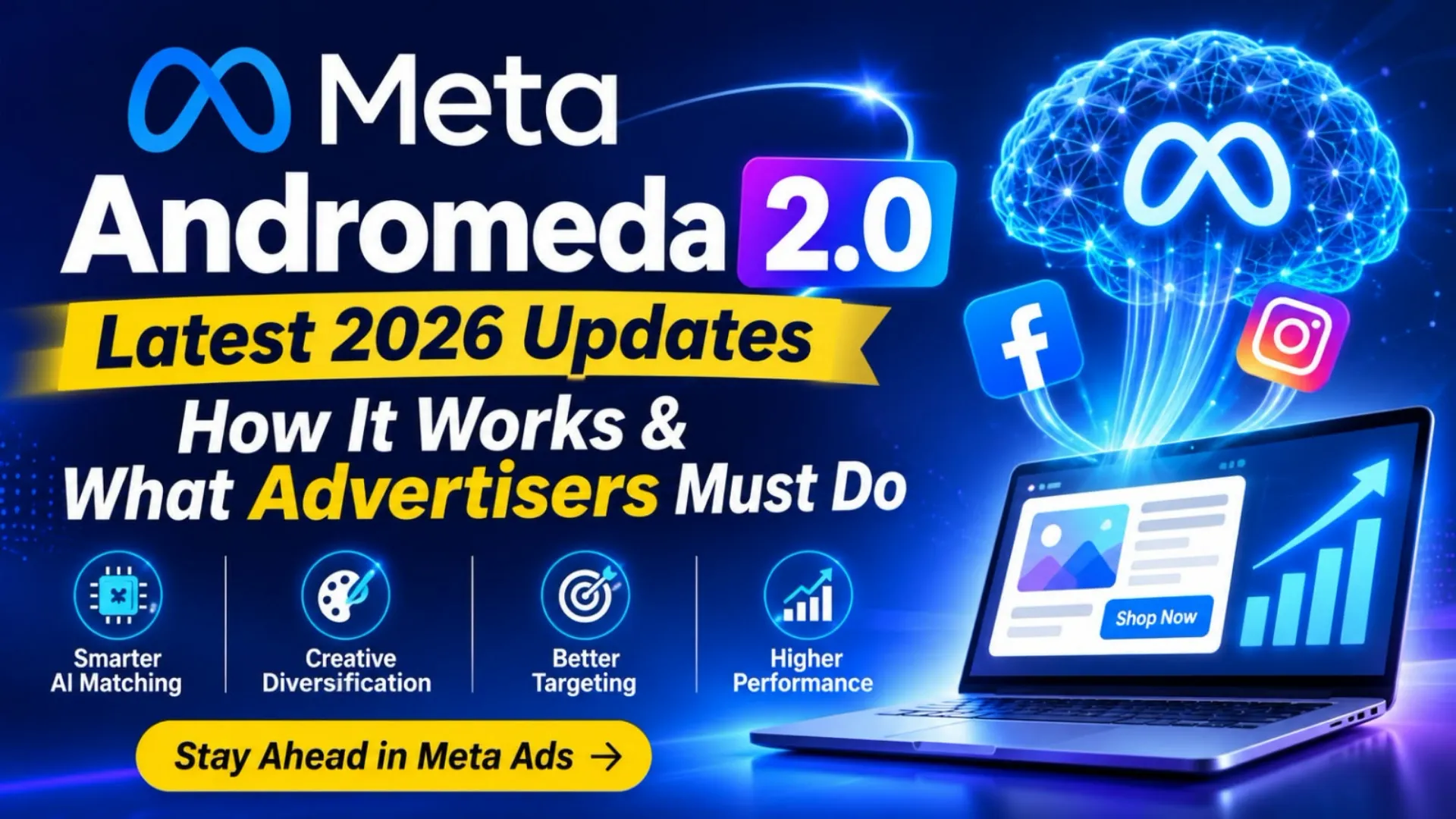
The world of digital advertising is changing rapidly. Artificial intelligence is transforming how businesses reach customers, how advertisements are delivered and how advertising platforms optimize campaign performance. One of the biggest developments in this transformation is Meta Andromeda.
With Facebook and Instagram becoming increasingly AI-driven advertising platforms, Meta has been investing heavily in machine learning, advanced recommendation systems and automated campaign optimization. Its Andromeda advertising retrieval engine represents a major step towards making advertisements more personalized, relevant and efficient.
But what exactly is Meta Andromeda 2.0? How does it work? Why is creative diversification becoming increasingly important? And what should businesses, digital marketers and advertising agencies do differently in 2026?
Meta’s latest engineering announcement on October 28, 2026, introduced the next generation of its Andromeda retrieval system, bringing significant advancements in AI architecture, processing efficiency and advertising recommendations.
In this comprehensive guide, we will explore the Meta Andromeda algorithm, its latest updates, its impact on Facebook and Instagram advertising, and the strategies advertisers should implement to stay competitive.
What Is Meta Andromeda 2.0?
Meta Andromeda 2.0 is an industry-used term for the next generation of Meta’s AI-powered advertising retrieval technology.
An important clarification: Meta officially refers to this technology as the next generation of Meta Andromeda, rather than launching a separate product officially named “Andromeda 2.0.”
Andromeda is Meta’s advanced machine learning-based advertising retrieval engine. It helps Facebook and Instagram identify and shortlist relevant advertisements from an enormous pool of eligible ads before more advanced ranking systems determine which advertisements should ultimately be displayed to individual users.
In simple terms, it helps Meta understand which advertisements are most relevant to which people.
Traditionally, advertisers relied heavily on manual audience targeting, demographic segmentation, interest-based targeting and multiple campaign configurations.
With the evolution of Meta’s AI advertising infrastructure, the platform is increasingly capable of identifying relevant audiences and matching them with advertisements based on multiple signals, including user interests, engagement behaviour, advertising content and conversion-related information.
The latest generation of Andromeda takes this process further through more sophisticated AI models and a significantly more efficient advertising retrieval infrastructure.
The central idea is simple: Better AI-powered matching can help businesses connect their advertisements with people who are more likely to respond to them.
History of Meta Andromeda: From 2024 to 2026
To understand the latest Meta Andromeda update, it is important to understand how the technology has evolved.
✅ December 2024: Introduction of Meta Andromeda
Meta officially introduced Andromeda in December 2024 as its next-generation personalized advertising retrieval engine.
The system was designed to improve how advertisements are identified and selected from millions of eligible advertising candidates.
Some of the important developments included:
- Advanced machine learning architecture.
- Deep neural networks for personalized ad retrieval.
- Improved processing capabilities using NVIDIA Grace Hopper hardware.
- Hierarchical indexing to manage an increasing number of advertising creatives.
- Better integration with Meta’s Advantage+ automation ecosystem.
- Improved personalization and advertising relevance.
Meta reported a 6% improvement in retrieval recall and an 8% improvement in ad quality across selected segments.
✅ 2025: Greater AI Integration and Advertising Optimization
During 2025, Meta continued improving its advertising recommendation and ranking infrastructure.
One important development was the integration of retrieval and early-stage ranking models into a more unified system.
In its Q3 2025 earnings remarks, Meta reported a 14% improvement in advertising quality on Facebook surfaces following improvements to Andromeda.
The platform also continued expanding automated advertising solutions, including Advantage+ campaigns.
This development reinforced the importance of allowing AI systems to evaluate more advertising opportunities rather than relying entirely on rigid manual campaign structures.
✅ October 2026: Next-Generation Meta Andromeda
On October 28, 2026, Meta announced another major technological advancement in its Andromeda advertising retrieval infrastructure.
The new architecture introduced several important innovations:
- Retrieval Mixture-of-Experts (MoE).
- More sophisticated user-interest modelling.
- Improved user-ad interaction prediction.
- Fused GPU processing pipelines.
- Greater retrieval efficiency.
- Better hardware and model integration.
Meta reported that its production system could process more than one billion eligible advertisements per second.
It also reported that improvements to Andromeda since 2025 had contributed to a 2.4% increase in conversions on Facebook.
This represents a major advancement in the technology powering Meta’s advertising ecosystem.
How Does the Meta Andromeda Algorithm Work?
To understand Andromeda, we first need to understand how Meta decides which advertisements users see.
Meta’s advertising system does not simply display every available advertisement to every user.
It follows a multi-stage recommendation and delivery process.
Step 1: Advertisement Retrieval
Meta initially works with an enormous pool of eligible advertisements.
Andromeda operates at the retrieval stage, identifying a smaller group of potentially relevant advertisements from this extensive pool.
It uses advanced machine learning models to evaluate the relationship between advertisements and users.
Step 2: AI-Based Relevance Evaluation
The system uses different information signals to understand the potential relevance of an advertisement.
These may include:
- User engagement history.
- Previous advertising interactions.
- User-interest patterns.
- Advertising content and creative information.
- Contextual information.
- Other relevant prediction signals.
The latest Andromeda architecture uses specialized user-model experts and more advanced interaction modelling to improve this process.
Step 3: Advertisement Ranking
After retrieval, more sophisticated ranking systems evaluate the shortlisted advertisements.
These systems predict different forms of user and advertiser value to determine which advertisements are most appropriate to display.
Retrieval and ranking are connected but distinct stages. Andromeda is primarily a retrieval technology, not the entire Facebook advertising algorithm.
Step 4: Ad Delivery and Optimization
The selected advertisements enter Meta’s wider delivery and optimization process.
The system works towards matching advertisements with users while considering campaign objectives, delivery constraints and other relevant factors.
Step 5: Continuous Learning
As users interact with advertisements and businesses generate new conversion information, Meta’s broader advertising models can use additional signals to improve future recommendations.
This is why accurate conversion tracking, meaningful creative variations and clear campaign objectives remain important.
Major Features and Technological Improvements in Meta Andromeda 2.0
The October 2026 update introduces important technological advancements.
Let’s understand the major developments.
✅ Retrieval Mixture-of-Experts (MoE)
One of the most important advancements is the introduction of a Mixture-of-Experts architecture into advertising retrieval.
Mixture-of-Experts is an AI architecture in which multiple specialized models, known as experts, handle different aspects of a prediction task.
Instead of relying on a single user model, the latest Andromeda architecture uses an ensemble of specialized user models.
This allows the system to better understand different user interests and changing engagement patterns.
Why does it matter for advertisers?
It helps Meta evaluate user-ad relationships more intelligently, improving the possibility of matching the right advertisement with the right audience.
✅ Advanced User Interest Modelling
People do not have just one interest or purchasing motivation.
For example, someone searching for digital marketing services might be interested in:
- Website development.
- SEO services.
- Social media marketing.
- Lead generation.
- Paid advertising.
The latest architecture incorporates different user signals and specialized models to understand more complex and changing interests.
For advertisers, this reinforces the importance of communicating different value propositions through advertising creatives.
✅Improved Creative and Contextual Understanding
Advertising creative is an important input into the wider Meta recommendation ecosystem.
Different advertisements can communicate different products, benefits, problems, solutions and purchasing motivations.
When a business creates genuinely different advertising concepts, it gives the platform more varied advertising material to evaluate.
For example, a digital marketing agency could develop:
- A video highlighting poor website performance.
- A creative explaining the importance of SEO.
- A customer testimonial.
- A lead-generation advertisement.
- A promotional creative highlighting a specific service.
These are different communication approaches rather than simple cosmetic changes to one advertisement.
✅ More Efficient AI Processing
Meta has also improved how its AI models and hardware infrastructure work together.
The latest generation introduces a fused GPU pipeline that combines different processing operations into a more integrated system.
This helps reduce unnecessary data movement and processing overhead.
Meta reports that the new architecture achieves near-ranking-level model performance during retrieval with approximately 300 times fewer inference-time floating-point operations compared with its 2024 Andromeda retrieval model.
For advertisers, the benefit is not a new campaign setting. It is an improvement in the underlying technology that supports ad selection and delivery.
✅ Improved Advertising Retrieval at Scale
Meta reports that its production retrieval pipeline processes more than one billion eligible ads per second.
This provides the infrastructure needed to evaluate an increasingly large advertising ecosystem, particularly as businesses create more advertisements using generative AI tools.
The objective is to improve the quality and efficiency of advertisement selection without compromising delivery speed.
How Does Meta Andromeda 2.0 Change Facebook and Instagram Advertising?
This is where the update becomes particularly important for businesses and digital marketers.
Although Andromeda is a backend technology, its development has implications for how advertisers should approach campaign planning and optimization.
✅Creative Strategy Becomes Increasingly Important
Previously, many advertisers spent considerable time experimenting with audience interests, demographic segmentation and multiple targeting combinations.
These elements still matter, but AI-powered matching makes the quality and diversity of advertising creatives increasingly important.
A business should not depend on one advertisement to communicate every benefit of its products or services.
Instead, it should experiment with different creative concepts, hooks, messages and formats.
✅ Audience Targeting Is Becoming More AI-Assisted
Meta’s advertising ecosystem is increasingly moving towards automated audience discovery and optimization.
Advantage+ solutions help advertisers automate different campaign decisions.
This does not mean audience targeting has become irrelevant.
Location, age restrictions, language, business geography and other genuine targeting requirements remain important.
However, unnecessarily narrow interest combinations may restrict opportunities for AI-assisted audience discovery.
✅Campaign Structures Need a More Strategic Approach
Creating numerous campaigns and ad sets for every small audience variation can make account management unnecessarily complicated.
A more consolidated campaign structure can help advertisers manage budgets, creative testing and performance measurement more efficiently.
The right structure still depends on the business model, conversion volume, budget, campaign objective and operational requirements.
✅ Creative Fatigue Needs Greater Attention
Creative fatigue occurs when an audience repeatedly sees the same advertisement and gradually becomes less responsive.
Businesses should monitor:
- Frequency.
- Click-through rate.
- Cost per lead.
- Cost per acquisition.
- Conversion rate.
- Engagement quality.
- Return on ad spend.
Refreshing creative concepts based on actual performance is more useful than changing advertisements randomly.
✅ Conversion Tracking Becomes Even More Important
AI-powered optimization depends on meaningful information about campaign outcomes.
If conversion tracking is inaccurate, incomplete or inconsistent, advertisers may struggle to evaluate campaign performance correctly.
Businesses should review their:
- Meta Pixel implementation.
- Conversions API integration.
- Event tracking.
- Lead tracking.
- Purchase tracking.
- CRM integration.
- Conversion event quality.
Accurate data helps businesses understand which campaigns are generating actual commercial value.
Creative Diversification: One of the Most Important Meta Andromeda Strategies
If there is one practical advertising principle businesses should take seriously, it is creative diversification.
Creative diversification means developing different advertising concepts that communicate different messages to different customer motivations.
It is not simply about creating ten versions of the same image with different colours.
The objective is to give Meta’s advertising system a meaningful range of creative options.
What Does Creative Diversification Actually Mean?
Consider a business offering website development services.
Instead of creating five advertisements with the same headline and design, it can develop five different creative concepts.
Creative concept Advertising message
✅Problem-focused Is your outdated website costing you customers?
✅Educational Five essential features every business website needs
✅Benefit-focused Turn your website into a lead-generation platform
✅Trust-focused Why businesses choose professional website development
✅Offer-focused Get a professional business website for your company
✅Each creative addresses a different customer motivation.
Different Creative Formats to Test
Businesses should experiment with multiple formats.
- Short-form video advertisements
Use short videos to explain a problem, demonstrate a solution or introduce a product. - Static image advertisements
Use clear visuals, strong headlines and direct value propositions. - Carousel advertisements
Present multiple products, services, features or benefits in a single advertising experience. - Testimonial advertisements
Show genuine customer feedback, experiences and results. - Educational advertisements
Share useful information that helps potential customers understand a problem and its solution. - UGC-style advertisements
Use authentic creator-style content and genuine customer experiences where appropriate and permitted.
The best format depends on the audience, placement, offer and campaign objective.
Meta Andromeda 2.0: Best Facebook Ads Strategy for 2026
Businesses should rethink their advertising approach rather than simply increasing their advertising budgets.
Here are the strategies worth implementing.
✅ Develop Multiple Creative Concepts
- Avoid depending on one or two advertisements for an entire campaign.
- Start with different customer problems, benefits, hooks and formats.
- Test creative variations that communicate genuinely different reasons to choose your business.
✅ Simplify Campaign Structures Where Appropriate
Avoid unnecessary campaign and ad-set fragmentation.
Organize campaigns according to meaningful business objectives, such as:
- Lead generation.
- Online purchases.
- Website conversions.
- App installations.
- Brand awareness.
Consolidate campaigns where doing so makes commercial and measurement sense.
Do not force every business into one campaign structure.
✅ Use Advantage+ Automation Strategically
Meta Advantage+ provides
AI-powered automation across different advertising activities.
Businesses should evaluate relevant automation features, including:
- Audience optimization.
- Advantage+ placements.
- Budget optimization.
- Creative enhancements.
- Automated campaign configurations.
Automation should support a well-defined strategy, not replace business objectives or measurement.
✅Use Broader Audiences When Appropriate
Test broader audience configurations when your product or service can serve a wider market.
Maintain essential restrictions, including location, age eligibility and other business requirements.
Compare broader targeting with more specific audience strategies using reliable conversion data.
✅ Improve Your Conversion Tracking
Ensure your advertising platform receives accurate conversion information.
Implement Meta Pixel and Conversions API where appropriate.
For lead-generation businesses, connect CRM information wherever possible to understand which leads become qualified prospects and paying customers.
✅ Test Different Advertising Hooks
The opening seconds of a video or the headline of an image advertisement can influence whether someone continues engaging.
Test different approaches:
- Problem-solving hooks.
- Curiosity-based hooks.
- Educational hooks.
- Benefit-driven hooks.
- Customer-experience hooks.
- Offer-based hooks.
✅Optimize for Business Results, Not Just Engagement
High reach, impressions and likes do not automatically translate into business growth.
Measure performance against actual business objectives.
For lead-generation campaigns, focus on qualified leads, cost per qualified lead and customer acquisition cost.
For e-commerce, measure purchases, revenue, conversion rate and return on ad spend.
Practical Meta Andromeda 2.0 Strategy for Different Businesses
Different industries require different creative approaches.
For Small Businesses
Small businesses should focus on communicating their core products, services, pricing advantages, customer benefits and trust factors.
Recommended actions:
- Test different creative concepts.
- Use local and relevant messaging.
- Highlight customer testimonials.
- Create problem-solving videos.
- Monitor lead quality.
- Avoid unnecessarily complicated campaign structures.
For E-commerce Businesses
E-commerce advertisers should test different product demonstrations, lifestyle creatives, customer reviews and product benefits.
Recommended actions:
- Develop product-focused videos.
- Test static and carousel advertisements.
- Use catalogue-based advertising where relevant.
- Experiment with different purchase motivations.
- Monitor cost per purchase and ROAS.
- Refresh underperforming creatives based on data.
For Service-Based Businesses
Service businesses need to build trust and communicate why customers should choose them.
Recommended actions:
- Create problem-focused advertisements.
- Highlight service benefits.
- Use genuine testimonials.
- Explain the service process.
- Communicate expertise.
- Develop different lead-generation offers.
For Digital Marketing Agencies
Digital marketing agencies should demonstrate their capabilities through different advertising concepts.
For example:
- SEO and organic growth.
- Website development.
- Social media management.
- Paid advertising.
- Lead generation.
- Business growth strategies.
Rather than promoting every service in one generic advertisement, agencies can create individual creative concepts around specific customer requirements.
Common Meta Andromeda Advertising Mistakes to Avoid
Understanding new advertising technology is not enough. Businesses must also avoid common campaign mistakes.
✅ Creating Multiple Identical Advertisements
Changing only the headline, background colour or minor design elements does not necessarily create meaningful creative diversity.
Focus on different messages, customer motivations and advertising concepts.
✅ Making Constant Campaign Changes
Frequently changing budgets, audiences, creatives and campaign settings makes it difficult to understand what is actually working.
Make changes based on performance data and allow campaigns sufficient time to generate meaningful information.
✅ Over-Segmenting Audiences
Creating too many narrowly divided ad sets can fragment budgets and complicate optimization.
Use segmentation when it serves a clear business or measurement purpose.
✅ Ignoring Conversion Tracking
Without accurate conversion data, advertisers may make decisions based on incomplete performance information.
Review tracking before increasing campaign budgets.
✅ Optimizing Only for Cheap Leads
A low cost per lead does not necessarily mean a successful campaign.
Businesses should evaluate lead quality, sales conversion rates and actual customer acquisition costs.
✅Depending Entirely on AI Automation
AI can help with optimization, but it cannot independently fix an unclear offer, poor landing page, weak sales process or uncompetitive product.
Human strategy and business understanding remain essential.
Meta Andromeda 2.0: A Practical 30-Day Action Plan for Advertisers
Businesses do not need to rebuild their entire advertising accounts overnight.
A structured testing process can help them understand which changes improve performance.
Timeline Recommended action Objective
Days 1–5 Audit existing campaigns, tracking and creatives Identify weaknesses
Days 6–10 Develop different creative concepts and hooks Build creative diversity
Days 11–15 Launch structured creative tests Identify promising variations
Days 16–20 Evaluate audience and placement performance Improve campaign efficiency
Days 21–25 Review lead quality, conversion tracking and costs Understand business outcomes
Days 26–30 Scale winning concepts and plan the next testing cycle Build a repeatable growth process
Important: This is a suggested advertiser testing framework, not an official Meta-mandated rollout schedule. The duration of each test should depend on the budget, conversion volume and sales cycle.
What Is the Future of Facebook and Instagram Advertising?
The future of Meta advertising will increasingly depend on artificial intelligence, automation, personalization and creative intelligence.
Several developments are likely to remain important.
✅ Greater AI-Powered Personalization
Advertising systems will continue improving their ability to understand user interests, contextual signals and advertising relevance.
✅More Creative Variations Through Generative AI
AI-powered creative tools will make it easier for businesses to develop and adapt advertising assets.
However, originality, relevance and genuine value propositions will remain essential.
✅Smarter Campaign Automation
Automated campaign management will continue reducing the need for manual adjustments in areas where Meta’s systems can optimize effectively.
✅Better Integration of Advertising Data
First-party data, CRM integration and reliable conversion tracking will remain important for measuring real business performance.
✅ Greater Importance of Creative Strategy
As advertising automation becomes more sophisticated, businesses will need to invest in understanding customer motivations and communicating their value more effectively.
The competitive advantage will increasingly come from combining good business strategy, strong creative execution, accurate data and effective AI-powered optimization.
Conclusion: Meta Andromeda 2.0 Is Changing the Future of Digital Advertising
Meta Andromeda represents a major advancement in how Facebook and Instagram advertising systems identify and recommend advertisements.
The latest 2026 generation takes this technology further through advanced AI architecture, Mixture-of-Experts modelling and more efficient GPU-powered retrieval.
For advertisers, the important takeaway is not that traditional advertising practices have suddenly become irrelevant.
Instead, the industry is moving towards a more intelligent combination of AI-powered audience matching, creative diversity, reliable conversion data and strategic campaign management.
Businesses that continue relying on outdated advertising approaches without testing new creative concepts, improving conversion tracking or understanding customer behaviour may find it increasingly difficult to maintain competitive advertising performance.
The smartest approach is to understand how the technology works, adapt your creative strategy, measure genuine business outcomes and use automation where it makes sense.
Remember: AI can improve how your advertisements reach potential customers, but a compelling offer, a strong creative message and a well-defined business strategy are what ultimately help turn attention into customers.
FAQ (Beyond the Blog)
Here are a few common questions developers are asking about Meta Andromeda 2.0
Meta Andromeda 2.0 is an industry-used term referring to the next generation of Meta’s AI-powered advertising retrieval technology. Meta officially describes the latest development as the next generation of Meta Andromeda.
Meta officially introduced Andromeda in December 2024 through its Engineering at Meta publication.
On October 28, 2026, Meta announced its next-generation retrieval architecture featuring Mixture-of-Experts, advanced user modelling and a more efficient GPU processing pipeline.
Yes. Andromeda is part of the underlying technology powering Meta’s advertising recommendation system. Its improvements can influence how eligible advertisements are retrieved and matched with users.
Yes. Meta introduced Andromeda across Facebook and Instagram applications. The system contributes to the broader advertising recommendation infrastructure.
No. Audience targeting remains relevant. However, AI-assisted audience discovery and automation make it important to evaluate whether unnecessarily restrictive targeting is limiting campaign opportunities.
Creative diversification means developing different advertisements that communicate distinct messages, benefits, customer motivations and visual concepts rather than repeatedly using minor variations of the same creative.
There is no official evidence that Andromeda universally prioritizes video over static advertisements. Both formats can be useful depending on the audience, placement, creative quality and campaign objective.
Businesses should evaluate relevant Advantage+ features and automation options based on their campaign objectives, budget, tracking quality and performance. Automation is not automatically the best choice for every campaign.
No. Andromeda is part of Meta’s underlying advertising infrastructure. Advertisers do not need to activate a separate Andromeda setting.
There is no universal number officially mandated by Meta for every campaign. The appropriate number depends on the budget, audience size, campaign objective and ability to produce genuinely different creative concepts.
Businesses should focus on creative diversification, meaningful audience testing, clear campaign objectives, accurate conversion tracking, suitable automation and continuous performance measurement.